
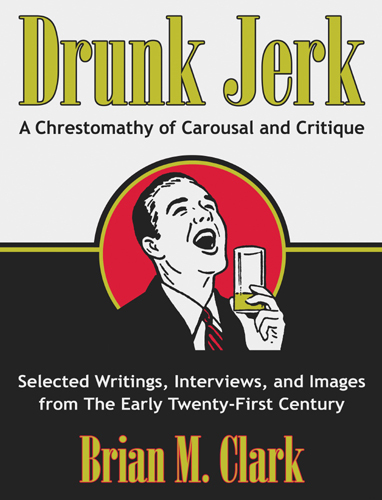
"Pray to Your Gods"
A Review of Brian M. Clark's Drunk Jerk
Genre: Essays / Interviews / Images
Languages: English / Español
Formats: Hardback / Paperback
Length: 340 pages
Dimensions: 8.5 x 1 x 11 inches
Publisher: Discriminate Media
Published: 2025
When I first came across the magazine Modern Drunkard, I was sold on its title alone. Since then, I have delighted not only in the publication's humor, but also in its weirdly practical instruction on how best to navigate the wide world of boozing. The magazine approaches dedicated drinking as a skill that one must carefully hone. I feel like any thinking drunkard would have trouble disagreeing.
Thus, it was with great anticipation that I received my review copy of Modern Drunkard contributor Brian M. Clark's newest book Drunk Jerk: A Chrestomathy of Carousal and Critique. And upon reading it I was not disappointed – but, according to its author, I should have been. In the book's preface, Clark maintains that anyone who pays "good money for this book should feel fuckin' ripped-off" because this collection of his early writings and "images" amounts to an oversized self-compiled collection "like a lowly fuckin' zine." And sure, there are many odds and ends on offer in the pages of Drunk Jerk. Because I have only dipped my toe in 'zine culture, I may be talking like a man with a paper asshole here, but in perusing this book I felt teleported instantly into my limited understanding and addled memories of that early internet age, that zenith of zany 'zine-ness. The selected writings and visual artifacts that make up Drunk Jerk—the interviews with underground musicians and artists, the propulsive prose, the charming home-brew layouts, the misanthropic outrage at how social constructiveness limits the possibility of human thought—sent me back that age of pre-social media media; recalling how the influence of 'zines and magazines waned as we got pulled more and more into what danah boyd calls "our segregated content streams," which narrow the possibilities of true discovery. One so easily forgets the degree to which algorithms limit our capacity for understanding, thought, and introspection.
And then one is shocked back into consciousness by perusing the surprisingly varied assortment comprising Drunk Jerk: outlandish elevator pitches for television shows; a brief polemic arguing the unfitness and unsexiness of strip clubs; a meaty portion of just plain freaky, whacked-out shit (like a blurb about a so-called rock band, The Mimes, who—you guessed it—perform their "rock music" silently to the disgust of a disappointed audience); or the account of a live performance at a Denver punk warehouse featuring a mix-gendered trio of French performers who violently assault one another's naked bodies with ketchup and chocolate pudding; or a weirdly sympathetic profile of Beethoven as a sort of proto-incel, thanks to the rigidities of bygone German social class. So, Brian M. Clark, I have a question: What's wrong with a 'zine?
The book's subtitle, A Chrestomathy of Carousal and Critique, while emphasizing alliteration over strict parallelism, proves accurate. "Carousal," while not a literary form, does point to the wanton decadence described within these pages, in which the author not only reports, but—in the case of prodigious alcohol intake—participates. In his travelogs Clark appears like Margaret Mead, dispassionately describing the natives while also partaking in their silly sauce. A handy photo of the author passed out (or, pardon, "relaxing") on a sidewalk in southern California conveniently illustrates this point. Yes, it's a chrestomathy in that one person created its contents; it's largely a collection of short, written pieces. But that term also suggests that this collection adds up to some sort of instruction or lesson. Could there be a moral lesson amidst the cynicism and debauchery? Instead of an unreliable narrator do we have an unreliable and self-effacing preface writer, whom we should not trust when he downplays the book as a mere "jumble" or a "hash"?
This all brings to mind that John Steinbeck—that cliché of California high school required reading—did write a book that some would call a hash. His novel Cannery Row, like Drunk Jerk, also describes a sort of idyllic debauchery, but also works as a kind of proto-On the Road. Like Kerouac's beatnik bible, Steinbeck's Cannery Row also features both a carefree Dean Moriarty figure and a riotous final party that spills into stealing cop cars for joyrides. The list of parallels between the two mid-20th Century American novels goes on. (Imagine if On the Road were published three years earlier, were less methy, and were much better written. Imagine if Kerouac had offered insight, built effective imagery, and were not stultified by a crippling lack of self-awareness.)
Anyhow, early in Cannery Row, Steinbeck depicts a scene in which the character Hazel (a protégé of the Dean Moriarty figure and thus part of "a little group of men who had in common ... no ambitions beyond food, drink, and contentment") helps a biologist (whom the characters call "Doc") collect sea anemone samples in a tidepool off the coast of Monterey. Hazel, an inquisitive but not intellectual type, asks Doc why stinkbugs stick "their tails up in the air," to which Doc says, "I think they're praying. ... If we did something as inexplicable and strange we'd probably be praying." In this sense, prayer, or at least accounts of different styles of prayer, reverberate throughout Drunk Jerk. In many pieces (like, for example, Clark's anti-pet polemic "Fuck You and Your Stupid, Stupid Cat") the author observes his chaotic universe from a Doc-like perspective; from a position of pure reason, a point of view not unlike that of an alien species exposing the foibles of human habits. (Why would a human own a pet? Even the staunchest pet-lover, as they clean up shit and vomit, as they suffer expense, inconvenience, and possible toxoplasmosis for an ungrateful pet, has to ask, "What's in it for me?") So pet owners must be praying. We all must be, in different ways.
David Foster Wallace gets way too much credit for having delivered the obvious statement that "everyone worships something." But obvious is another way to say self-evident truth. Clark's meditation on human habituation in Drunk Jerk, "Spoiled for Choice," asks us to consider why we unthinkingly pray to that which we pray to, which is determined not by us, not by any sort of objective truth, but rather by the mere fact of geography. This in turn determines how we speak, how we act, what we say. As he points out, we don't even really choose our preferred condiments, after all.
So does Clark helpfully tell us what we should worship? Does he care about us? Or are we too hopeless? Is there something that Clark himself worships? The answers are "yes," "maybe a little," "pretty much," and "definitely yes." Sure, he worships the scintillating transcendence evoked by serious cranium-crakin' boozin' (check out the book's opening manifesto, "Why I Drink" for a thorough exposition on the merits of the topic). Clark may even worship the drunken camaraderie that comes along with it.
Looking past Clark's stern visage in his about-the-author headshot in the back of Drunk Jerk (pairing nicely with a "DON'T TALK TO ME" lapel button), and looking past his exasperation for the lack of human imagination, one may interpret this collection as an admonition for us all to think better, to apply reason, to learn, even to value real journalism, to keep clear the distinction between logic and feeling, to maintain the difference between thinking and reacting, and to call out certain media sources for publishing the middling prose of figures who may not understand the difference (as he does in the case of Vanity Fair publishing Henry Rollins). So if this collection has more connection than a hash, if it has some sort of monetary value, it comes in the cleverly entertaining form of needed reminders of how simple primate emotions divert us from our own best interests. Therefore, and I say this with kindness – go get yourself "fuckin' ripped off," and pick up a copy of Brian M. Clark's Drunk Jerk, already.
— Sean Smith
Sean Smith is a professor of English at Cerritos College in Norwalk, California, as well as a writer and musician who plays in California's Long Beach-based bands NightFoot and Ixylnur. Despite his library card and his bad habit of buying too many books, he is often heard to complain, "There ain't nothing to read!"